
How to play Texas Hold’em

Poker exists in many variants, but Texas Hold’em has become one of the best-known forms of the game in casinos and organised tournaments worldwide. It is a community-card poker variant that is commonly played in both cash-game and tournament formats, with No-Limit Hold’em especially prominent in major live competitions. The game involves more than recognising strong card combinations: long-term decision-making also depends on factors such as table position, bet sizing, pot odds, stack management and adapting to the actions of other players. Texas Hold’em remains an important part of major international poker series. The 2026 World Series of Poker included both Limit Hold’em and No-Limit Hold’em events, while the World Poker Tour continues to feature No-Limit Hold’em tournaments in its event schedule. Its established rules, changing table situations and strategic depth have made Texas Hold’em a standard format for recreational games as well as professional tournament poker.
The rules of the game
Each Hand is dealt in a Full deck. One player takes on the role of Dealer (which changes clockwise after each hand), and betting is done in a similar fashion. Each hand consists of four moves, and each move is followed by a round of betting:
- Preflop. Everyone receives two cards, which are dealt face down.
- Flop. Three cards are dealt face up in the middle of the table.
- turn. The fourth card is dealt face up in the middle of the table.
- River. The fifth card is dealt face up in the middle of the table.
The goal of the game is to form a top combination of 5 cards, using 2 of the player’s process cards and 5 total cards.
Whenever a player raises the bet, the other players must call (i.e. support), fold (i.e. surrender and lose the money already bet) or raise the bet even more. On the preflop and flop, players bet $1 at a time, and on the turn and river they bet $2 each.
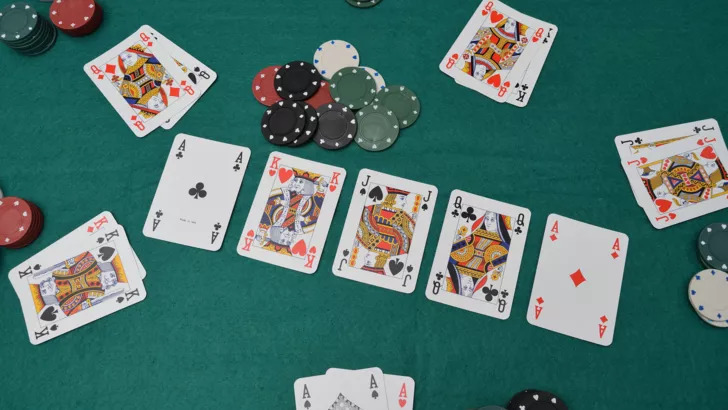
Ranking of poker hands
Possible five-card combinations in poker are ranked in order from highest to lowest. They look as follows:
- A straight flush is five consecutive cards of a single suit. Aces may be ranked above kings or below twos. If several players have straight-flushes, participants compare the higher cards of their straight-flushes (the higher card wins).
- A flush royal is the highest combination.
- a four – four cards of the same rank.
- Four of a Kind – the higher ranked card wins when compared.
- Full house – 3 identical cards of the same rank and 2 identical cards of a different rank. If several players have full houses, the player, whose set of three cards has the higher rank, wins.
- Flush – all 5 cards of the same suit. If more than one player has a flush, the player with the single highest ranked card wins. In situations where both players have the highest card of the same rank they compare the rank of their second highest card, then the third highest card, etc.
- Straight – all 5 cards in order. As with straight flushes, the aces can be either high or low, and the 2 straight cards are matched by the highest card.
- Three – 3 cards of the same value and 2 unpaired cards. 3 identical hands are compared by the rank of a set of three cards.
- Two Pairs – 2 cards of the same rank, 2 merit cards (matching each other but not the first two cards) and 1 merit card. Two identical hands are compared by looking at the pair with the highest rank of each player (the higher rank wins).
- One Pair – 2 cards of the same value and 3 cards of different values (either from the pair or from each other). Hands with a single pair are compared by first considering the rank of each player’s pair and then, if necessary, considering the rank of each player’s unpaired cards in the same way as for a flush.
- The high card is a set of 5 cards that do not fit into any of the above categories. Hands with high cards are compared based on each player’s card rank, as described above in the case of a flush.
There is no ranking of suits in poker, so two players with the same hand, but in different suits, share a hand and split the pot.